So,
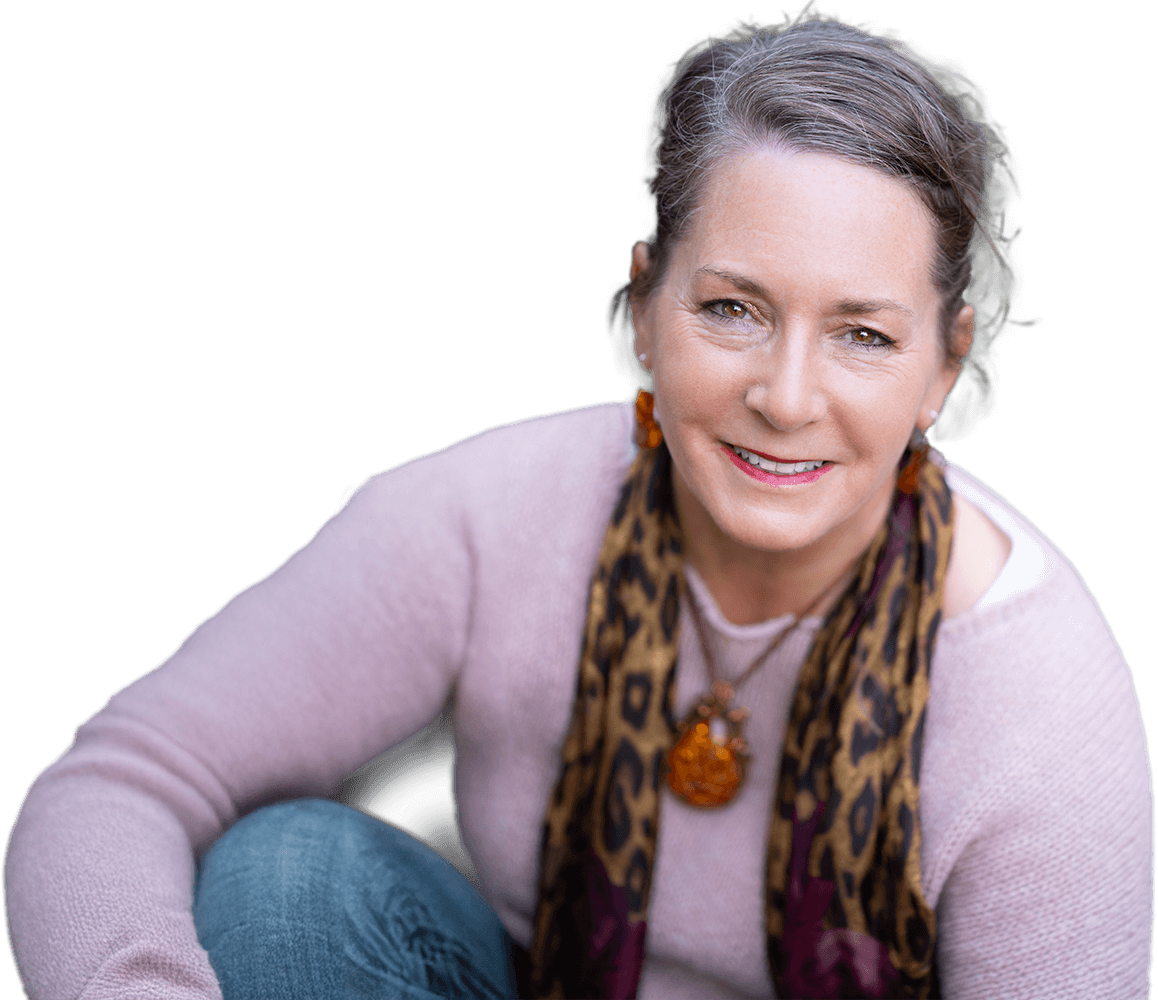
all right. Hello everyone and welcome. Welcome to the Yin-care® podcast. I’m your host, Margaret Jacobson, The Mother Rising, and I have such a treat for you today. I was recently in another one of Zhang Ming, we also call her Xi’s womb containers, and this one was titled The Resurrection of the Womb Temple. It was another incredibly powerful and might I say epic journey.
Consisted of 12 modules and lasted from November 16th, 2025, all the way through till February 14th, 2026. And I have to say, I am totally missing all of my sisters and the weekly meetings, big time. It’s a very intimate and vulnerable space for super deep healing. And on our eighth module, we covered the heart and we had this amazing guest who walked us through breast massage in a deeper, more spiritual way than I had ever been taught.
I have received breast massage instruction from my studies with Montek Chia Healing Tao, from several other workshops. Some of them specifically dedicated to just a breast massage workshop. So I’m not a newbie to breast massage, but what my guest today has to offer. It is so much more than just breast massage and so much more than anything I’ve ever experienced.
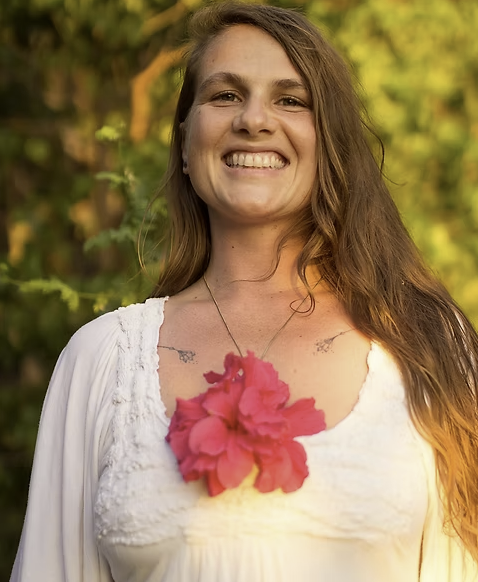
I feel like what she has to offer is incredibly life-changing material for all women. So pay attention and buckle up. What you’re going to receive today is an introduction to a profound awakening to your breasts as a space of anchoring in a way to honor your body temple. My guest is going to completely dismantle your relationship that you have right now with your breasts as sexual or pathological, and transform it into a space of deep reverence, a space to cultivate your love for yourself, and a space to honor your body’s technology for nourishment, not just for your baby, but a way to tap into nourishing yourself, your relationships, your community, and the earth. So my guest today is Abigail Hines of Bless our Breasts, Abigail’s, a healing practitioner, a highly specialized body worker, educator, and trainer, devoted to holistic breast health and supporting women to come home to the sanctuary of their bodies and essence.
She’s a weaver and vocalist, a medicine song carrier who brings devotional feminine medicine and artistry to all her offerings. Abigail is also the founder of The Breast Health Sanctuary, a space that offers lymphatic breast massage and holistic breast health education to women. Through the sanctuary Abigail supports health conscious, spiritually attuned women move from dense. Fibrocystic, heavy and anxious, feeling breasts into soft, flowing, vibrant tissue, deep embodied connection. She travels internationally to offer trainings, education, and hands-on care. And her offerings combine pr, practical education, ancient wisdom, advanced tissue work, and deeply reverent loving presence to support women to heal and transform their breast tissue, prepare for healthy breastfeeding, and prevent cancer.
Without further ado, let me welcome in Abigail. Abigail, welcome to the Yin-care® Podcast. Thank you so much. Yeah. I’m so excited to be here with you today. I’m so, so happy to have you here. It’s just a joy and I’m also like super happy because I don’t know if you know this, but the organ that’s associated with the year of the horse is the heart.
So, tending to our hearts this year is really incredibly important and I just love that we are leading with this interview as actually I think it’s like our second, second full interview in season three of the Yin-care® podcast. So that to me is just super cool. Yeah, I love that. I’ve definitely been been feeling into that as well, that this is a heart year, the fire energy.
Definitely. Absolutely. And so I thought we would start, because it’s such a unique profession that you have created, that you could maybe tell us your story and how you came into this line of work, how you fell in love with breasts and what your breast love story is. Yes, I love that question. So yeah, I entered into this field through winning a raffle ticket for a free breast massage session at a women’s gathering.
And I had a very profound experience receiving this breast massage. And also I took a mini, you know, like two three hour workshop on breast health and I was so in awe of this, you know, at, at the time I had already been connecting to my womb and doing womb healing. That had been a big part of my pathway actually into the realms of holistic healing and into the realms of the feminine body.
So when I was learning about this breast care, it, it felt so similar to when I first learned about my womb cycles and womb medicine. You know, I was like, this feels so important. This feels so vital to being a woman and having a female body. Yet I’ve never even heard or heard of this. You know, I’ve, I’ve never heard anything about breast massage or breast care.
Really? Yeah. Um. So I felt very just drawn to it. You know, something inside of me was just like, I need to learn more. I need to learn all about this. And that kind of, that was the beginning of my journey. And I, I ended up studying, um, Ayurvedic medicine and lymphatic body work and getting into the breast massage.
Mm-hmm. Um, and after I had done a certain amount of practice and apprenticeship, I started doing breast massage sessions. So I did a, for a while, I was doing a by donation breast clinic. And yeah, I was doing 45 minutes to an hour of sessions just on the breasts. So just on the whole breast, chest, underarms.
And this is where very quickly I started to see just how much was going on in women’s breast tissue. Mm-hmm. And also how little women’s breast tissue was actually being tended. Mm-hmm. You know, and that, that kind of combination. I saw how much of a need there was for this and just continued to keep offering breast massage sessions.
And even for, for many years I was actually mostly exclusively doing just breast massage sessions. Because it was, yeah, this area of the body that seemed to be left out of care. Mm-hmm. And even of massage and of, you know, alternative therapies, it. It was like the breasts were, were being kind of neglected.
They weren’t really being included in a lot of things. And yeah, so I started to, I started to get really familiar with that realm, you know, and with women’s breast tissue and that, that space with women, like it’s a very, it can be a very tender space, you know? Mm-hmm. And so many women who I’ve worked with and still work with, a lot of times it’s their first breast massage session ever.
It’s possibly even the first time that their breasts have received, you know, non-sexual nourishing therapeutic touch. So it’s. Yeah. It’s such a powerful space to be in with women. Yeah. And that was, yeah, that was my kind of falling in love with, with the breast massage of, I felt really naturally just, just drawn to it and, and able to hold a certain, I think comfortability and groundedness within that space Yeah.
Where women could feel comfortable, you know, opening in that way and receiving care from me. I’ve noticed that in my trainings as well, you know, I think it’s a particular calling, you know, those of us who are called to tend to women’s bodies in these ways. Um, you know, similar with like doulas or midwives, or womb healers.
There’s just. This particular kind of Yeah. San Sanctuary space, I would say. Yeah, that is created that, and I, I think is required, is necessary to offer this kind of hands-on care to women’s bodies. And so I found that I really loved creating that space, creating that kind of sanctuary space for women to Yeah.
Receive care and nourishment. And I think also with the breast massage sessions in particular, the breasts are so responsive. And so it’s really this, there’s something about that space that. If I, if I was giving regular full body massages, I would not be able to do very many in a day. But if I was giving breast massages, like I could do so many more.
’cause there’s just this, yeah, this heart medicine, this feminine medicine, this reciprocity that I find in that space, that is so nourishing. And yeah. And just seeing women, you know, inhabit that area of themselves more and so often have this glow and this, you know, very real, noticeable impact from this session really lit me up too.
Yeah. Like the sessions in general will light you up. Yeah, I can imagine that. Yeah. Yeah, yeah. I’m curious because I actually worked for a massage school as in a, in admissions, like, as one of my first jobs out of college or, you know, first couple of jobs outta college. Right. And so did you go to a traditional massage school as well, or did you, um, how, how are you, I’m just curious.
Like, because they’re so strict about licensing and like they’re, you’re taught in massage school to not touch the breasts. If anything you’re, it’s draping and, you know, we’re avoiding that area and which is so unfortunate. Um, so I’m wondering if you could speak to that a little bit. Yeah. So, I did li like lymphatic, full body lymphatic Ayurvedic massage training.
And yeah, with the breast massage, it is unique in that it’s actually in the US at least the legalities vary state by state. And I have a really great resource that this woman created of breaking down, through to the different states. So I mean, in some states it’s technically illegal. In other states you’re supposed to have, like, you’re only supposed to do it if you have a doctor’s recommendation.
Mm-hmm. In some states like California, you can do it with, what is it called? A letter of consent. Mm-hmm. From the person, Oregon. I think it’s like you can do it with. You, you have to have a letter of consent and you have to have additional training, additional breast specific training. Because yeah, it’s not something that’s taught in traditional massage schools.
It is a traditional part of Ayurvedic massage. Mm-hmm. But obviously still not necessarily practiced in the states different places, depending on what it is.
Yeah, so that’s definitely a barrier. You know, I was actually really thinking about this this morning of like what that might look like to help it become more available. Yeah, even, even running certain studies, you know, to show the benefit of breast massage and show how helpful it is, for even screening purposes and these things to help it become more legalized, become more available.
And so I’m just gonna interject like my 2 cents there because I’ve watched for so long, I’ve been in this field that people would term, I call it other medicinal therapies. I don’t like it to re-referred to as alternative or complimentary because that’s, that is saying that it’s in relationship to something else, being the bigger form, bigger, better form of medicine, which I refer to as the western medical industrial complex.
Right? Yeah. I love that. And for those of you, I like, I, I don’t give any caveats. We all know intuitively what parts of that system are good and what parts are not good. So I’m not gonna say anything more than that. I, I acknowledge that piece. But what was I gonna say? That as far as bringing things into more, you know, availability for women.
I’ve found so many people that are in the this field that they will go, they spend all their time bending over backwards to prove something. And it’s so much wasted energy when really the most important thing is bringing the message to the women. You know, bringing the message to the pr, the good practitioners that can refer the women, and the women need to create, like, we all need to take that responsibility upon ourselves and recognize intuitively that this is fricking important.
This is, this is, this is absolutely critical as, as important as it is. Like, I would also say being in touch with our menstrual cycles and really embracing that as part of our health. Also embracing our, you know, our breast health. It, those are two incredibly. I mean, they will, they will be absolutely life changing.
If there’s two things that you could do for yourself over this year would be getting in touch with your menstrual cycle and attending to your breasts. And so Abigail’s gonna, we’re gonna talk to her today more about what those resources might be. But let’s not, let’s not sit around and wait, like for there to be science that backs this up because I know that as you’re listening to this, you’re, you already know this is important. You’re feeling it in your heart. I know it, you know, I know it to be true. What was I? Yeah. Thank you for bringing that. Yeah, totally. Go ahead. You were, you can finish what your, your thought was. Yeah, just, just on that thread, that’s, that’s something I hold very strongly in this work is that it really is, you know, ancient feminine medicine, right.
This, I’ve felt it so much in sessions and in spaces and in touching my own body. It’s like these ways are actually ancient. You know, it’s actually how women across the world, across different cultures would tend to our female bodies, you know, and tend to each other in these, in these sacred ways. But yeah, it is, I’m, I’m a really big proponent of, you know, I mean, receiving breast massage from a skilled practitioner is amazing when you can, it’s, it is a different experience than doing it yourself and.
Even if you have access to that, I think we still need to be touching our own breasts. Mm-hmm. Because they actually need and want, you know, more touch and movement and care than is just, you know, a, a monthly session, which is way more than most mo women, you know, even would get to have. Yeah. And I, I re and you also mentioned at one point in the workshop that, that I was with you in that you, you oftentimes have worked helping women.
Almost teach their partners how to do breast massage too. And so that’s another way, like we don’t necessarily have to go receive it, you know? I mean, ’cause it’s gonna be hard to find, let’s face it. Yeah. And, and that in and of itself is like such a gift, right? Like, if we could bring this into our lives in a way that we learn to touch our own breasts, and that we can also talk to our partners and pass over some oils and say, I really would like this.
Could you, you know, this really helps me. This is really important for my overall health. It’s not, you know, and I, and, and then they get to shift from it being a purely sexual thing to really just tending to a woman’s body. I mean, there’s like so many layers here, right? Mm-hmm. Yes. Absolutely. Actually, a woman from one of my trainings last year.
So I do practitioner trainings where I do train women how to give- nice- therapeutic breast massage. And one woman, from a training, she actually just a few weeks ago, I think for Valentine’s Day, she did a workshop, an in-person workshop to teach people, men how to give to their partners. Wow. That is so cool.
Yeah. What a great idea. That definitely, that’s been a, a vision of mine for a few years. I haven’t actualized it in an in-person experience, so I was so excited that she did that. But yeah, I agree. I think there’s so many layers of healing and medicine to that. And it’s such a great way if somebody has a partner to get to receive mm-hmm.
You know, breast massage and that, that flow and movement and Yeah. To receive that kind of. Just loving, giving touch from a man. Totally. Especially on the breasts, I think. Yeah. So, or a woman if you’re partnered with a woman too. Yeah. You know, I mean that because, because our issues with our breasts are, you know, doesn’t really matter what type of person you’re with.
You know, we’ve, there’s, there’s so many cultural layers. I was gonna add to this little piece of the conversation that I did receive a breast massage once, a very quick, what I was in Fiji, I was traveling and mm-hmm. Had gotten a massage and the, and part of the massage included the breast, which would be completely natural.
But that was very odd for me as this American woman coming. And I was just like my sister-in-law at the time was like, you know, she’s gonna touch your boobs, you know? And I was like, what? Like, are you serious? And, and I was, you know, I, I really am. I am pretty. I’ve always been, had some level of, just deep comfortability, I guess you would say, like with my body.
So it wasn’t, I didn’t push her away. I didn’t flinch or anything like that. I just sort of experienced it. But I remember being really very surprised by it, you know? Yeah. I’ve heard that from a lot of times if somebody has had a breast massage, it was in Thailand or another country where, you know, they just incorporate it.
Which even that, I think it’s even, it’s a slightly different than the kind of breast massage that I have done of, like, I, I definitely, I mean, yeah, a full hour, you know, just in the breast. So I do a lot of deeper tissue work and I think there’s parts of that that really is for the modern day woman, you know, and our modern day breasts that I think have a lot more just stagnation and congestion than probably ever before.
And so yeah, talk about that. Talk about how, like what, because an hour seem to, to somebody that’s just listening to this would seem like, wow, how would you spend an hour and why? And so one of the things that you talked about in the workshop was, you know, the, there being these rivers of the lymphatic rivers that you were talking about, and how there’s ways they can get really back blocked up basically, and blocked up from.
I mean, so many different things in my mind, I’m thinking, you know, our mental emotional constriction, our relationship with our breast area, the fact that we, many of us will be wearing, um, you know, bras that are, that are creating a lot of that stagnation. And so the idea is you, you can explain this to, to open that flow and that, like I said in the intro, that you, you know, your whole purpose is to have these like soft flowing, you know, juicy breasts basically.
So talk, talk a little bit about that and why that’s important and what you find in women’s breasts and how you work through it with them. Yeah, yeah. So this is really getting into, how the breasts are designed, which is this thing that we’re just not really taught about. Most people don’t know, but they’re actually very fluid by nature.
So there’s a lot of lymph in the breasts and lymph nodes. There’s the mammary glands that make the milk. And then there’s a lot of fatty tissue and yeah, these lymph channels go into the breast, so coming from the upper chest here and then actually all the way under the arm. And on the side of the breast here is where these main lymph channels, lymph rivers go into the breast and then become these kind of smaller tributaries or smaller rivers in the breasts.
But there’s a ton of lymph in the breast. There’s a ton of lymph nodes under the armpit. And yeah, the four, you know, the way that the lymphatic system is designed and the way that the breasts are designed as part of that is that they’re naturally meant to clear, to clear out toxins and, you know, so-called foreign invaders or just things that aren’t good for our body.
And these, these main channels that go into the breasts are a huge part of that system. Mm-hmm.
Hmm. So they’re taking, they’re taking fluid out of the breast, or are they bringing fluid in too? Both. Both. Yeah. Both. So, so just really opening them up so there’s flow is that. Yeah. And essentially for the breasts to, to stay in health, they’re meant to be in that flow. All of those channels and rivers are meant to be open and flowing.
Mm-hmm. Yet, in our modern world, so often, I mean, full body, there’s a lot of lymphatic stagnation in many people’s bodies, but especially in the breasts, especially because of bras, oftentimes the, those lymph channels are not flowing in and out of the breasts, so they can get completely blocked up and congested.
They can get dried out, and so there’s just not that water that fluid anymore. And yeah, there’s, there’s so many different reasons in our modern world why the lymphatic system can get blocked. A lot of times it is. On a core level from overload of toxins, including, you know, toxic emotions, toxic experiences and lack of movement, right?
Lack of space, lack of safety to actually process those things and have them naturally alchemize and move through the body. So they’re just gonna add one more thing that I’m curious that you’ve probably come up against too, which is our negative views of our breasts. Like, we have had it planted in our, in our culture into our mind that our breasts are supposed to look like one certain way.
And so there’s this constant and, and comparison, you know, and it’s surprising to me that it’s still existent. Like it, it’s probably worse than it was when I was growing up, you know? I mean, I, I just was surprised because I, I was very flat chested, you know, growing up. And so my, my friends would call, they call when I, my little boobies started growing.
They called me pencil points, you know, and it was, you know, and so of course like I was very self-conscious. But you know, after having, after having kids, you can’t totally see. But, you know, I’ve got, I’ve got some boobs now, but, you know, they, um, but it’s hard for like my daughter watching me, I think.
You know, the way I looked at my mom’s breasts, it was hard. I mean, my mom definitely has bigger breasts than I do, but you know, it was hard for me to ever imagine that my breasts would, would be a different size or would change shape with as my life went through. And so, there’s no, because we’re so disconnected from, from, from the life cycle of the breast in, in, for a woman.
Yeah. And this was also brought to me to add one more thing on this, um, the other day I was talking, oh, ’cause I do this radical birth keeping and we were doing a case on a, a birth reclamation, debrief, which is basically women who’ve been through traumatic, you know, births to help them to kind of assimilate the pieces of what happened and reclaim themselves in that.
And so one of the things that was in this particular case was this woman, you know, basically being shut down from, from her breast milk and, and feeding and as it related to the trauma of what had ex she had experienced in the birth. You know, it had ended in a c-section. This happens, and this happened with me.
I had a cesarean section with my first and my, I was, I was incredibly traumatized by what happened. Mm-hmm. And so my breast milk really just had, it took me a, a while to really have a natural flow and to feel the let down and everything. And and my thought was at the time when I, when this happened, and I was reminded of it the other day during this debrief, was just that if we were exposed to just visually watching other women breastfeed regularly in our culture like that, we would almost already know, we would almost already have developed the feeling of what it is to let down.
Like, and, and in fact, I don’t, obviously, I’m not, I’m not nursing anyone, but you know, when I do my own breast massage, there’s a, there is like an a moment when the chest relaxes, you know, like there’s this like opening that you can feel happen. Mm-hmm. And that’s almost like what happened. I mean, there’s this interesting tingling sensation that happens with the milk letting down.
I won’t deny that, but. There is a heart opening that happens at the same time. So I think you can achieve some of that with the breast massage. Mm-hmm. Yeah. You’re speaking to so many powerful pieces. I definitely agree. I think starting a breast massage practice and starting to connect with your own breasts before conception -mm-hmm-
is so incredibly helpful. Is like one of the best preparations you can do for breast massage. For many reasons, but I think, I mean, just what you described, that, you know, being able to relax and for them to, you know, feel comfortable to, to hang and to open and then. Yeah. To start also, if, you know, if someone’s breasts have a lot of congestion, if they’re really dense or cystic or all that stuff, a lot of times that can become amplified when, you know, they start to grow in pregnancy and, and can cause blockages and challenges to be able to breastfeed.
So also just starting to help some of those layers clear and process so that the breasts and that these channels of flow and of fluid are more open. Mm-hmm. And, you know, more ready to flow. And then on an energetic heart level, I’ve heard that from so many mamas that it was kind of a shock to after they had their baby and then to start breastfeeding and that their breasts just became like the center of the universe, you know?
Mm-hmm. The, the breasts are suddenly like the main thing going on all day. Definitely. If someone’s not, hasn’t connected with her breasts at all before that, it can be kind of shocking and it can even be challenging. It can be more painful. It can be hard. So yeah. First like anchoring and developing that relationship yourself and with your own breaths, um, yeah.
Is so helpful. Yeah, and I think that also the, what you said, what you were speaking about before, that with the, you know, self-hatred and criticism and it’s, it’s like one of the deepest mind viruses that. We have as women. It’s actually, I mean, I just saw my friend was sharing about it today. It’s, it’s really a form of spiritual warfare.
It, it absolutely is. It’s like our minds, you know, get infected with this thing where we hate ourselves, we hate our body. We’re hypercritical. We just always are wishing that we were this way and that way. And different, and especially with the breasts, you know, the, they’re very outward. Right. Our womb is so deeply inside of us.
It is so internal, but our breasts are forward facing. They’re out, there mm-hmm. In some ways visible. Right? And so, and they’re actually, yeah, the most forward part of our body, right? Our breasts meet the world in reality before any other part of ourselves. So I’ve found that, you know, in doing workshops and holding circles and just listening to so many women’s stories, like thousands, thousands of women’s stories about their breasts.
Most all of us have some, you know, some way that we’ve had to navigate being in a world where people can see our breasts. Whether that’s like, oh my gosh, my breasts are too small, or my breasts are too big and they’re getting all this attention. Or, I, you know, there’s just so much to navigate living in a cultural world where, or I’m breastfeeding and people are uncomfortable around me.
And I, you know, like I actually, I was like, I was so outward with breast. I was in, I was in Oakland, in Berkeley at the time that I was, had my young kids and everything. They had like some kind of a, a breast feed in, it was like, they were doing these records of how many women they could have in a room, like to breastfeed.
Do I do somewhere have this like picture of the, we were in the paper. The woman that was, they took our picture in the thing, you know, with all the other women behind us. But we were like front and center. But it was pretty cool. I gotta say, I think it was like Berkeley Community Theater we were in and it was filled with women.
Wow. Yeah. You do not see that every day. That was No, that was pretty cool. Was very powerful. Yeah, I forgot about that. I just remembered that. Uh, yeah, so what another thing I wanna talk about is because there could be women that are listening to this, that we haven’t really talked about breast cancer and this fear, fear.
Based system that has been put on our breasts. And I also wanna acknowledge women because there’s no shaming here for any choices that you’ve made or any, – mm-hmm- you know, ways in which you’ve navigated this very challenging cultural imposition, you know? And, and it’s your story and it’s your life, and it’s your choices.
And that’s all that I am about here at Yin-care® is figuring out what’s the next best thing for you and empower and having women step into their own power around making their own best wise choice. So that being said, let’s talk about the fact that some women don’t have a breast or breasts or they’ve had pieces removed.
And then let’s also address, you know, augmentation and implants as well. Yeah, yeah. Great. So actually, you know, breast massage is amazing. It’s one of the most helpful treatments for women who have gone through surgeries, any kind of surgeries in their breasts, or also cancer treatments, radiation or chemotherapy.
Breast massage is so helpful for supporting the scar tissue and even for some women, can be life changing for bringing back mobility in like their arms and and movement around that whole area. Just sometimes, yeah, bringing more openness and ease. Like sometimes scar tissue and different surgeries can create certain tension patterns and blockages that can be really uncomfortable.
Mm-hmm. So breast massage is a really great practice for that as well.
What was, there was something else I was gonna say there.
I don’t remember. That’s okay. But it’s similar with also, I mean, any implants or augmentations when it’s similar, there’s been a surgery, it’s a bit different if there are implants, if you’re just, you’re not working with the actual tissue of the breast as much, but all around the area is still just so helpful.
Mm-hmm. And oh yeah, this is what I was gonna share. There’s a beautiful woman in one of my trainings this year, and she had gone through breast cancer twice. The first time was something like 18 years ago, and then again, just a few years previously. And in the training, she was receiving breast massage for the first time.
And then I ended up doing multiple sessions with her afterwards. And the effects were so noticeable and so helpful, just supporting, you know, things had gotten just really, really tight, really kind of squeezed in where she had surgery to remove a tumor, and the radiation on the tissue. The breast massage just massively, noticeably softened everything and helped it open up.
And her oncologist, when she went to him after, was like, was really impressed and was like, whatever you’ve been doing, keep doing it. ’cause that’s amazing. But yeah, it’s, and she also just receiving the breast massage was almost in like ecstasy of just the feeling, the love of it, feeling her breasts, you know, receive this love on a cellular level.
Mm-hmm. And she was kind of shocked that she was like, I can’t believe I’ve gone through. And she herself was a body worker, so it’s not like she was just in the mainstream realms. Right. But she was kind of shocked that she had never received that, you know, from herself or someone else. She hadn’t even gotten that just you know, hands on nourishment. So it’s such a beautiful practice. And even too, I’m just feeling rose, the medicine of rose, like using a rose oil. Mm-hmm. Um, or working with different plants in the breast oil and also that, you know, after, after surgeries, after being cut in those places or having those traumas just bringing so much tenderness and love and care and, yeah.
Healing to those spaces. Absolutely. Because, I mean, really the whole emotional component that’s been. Infected in those areas prior to and during the surgery and even post is fear. I actually worked on a women’s health study on survivors of breast cancer where we interviewed women at the five year and the tenure year point.
Um, and Oh, amazing. And it’s all about, like, there’s this, I mean, just the fact that there’s like a five year survivor study and a 10 year survivor study. It’s like there’s this whole idea that like I, there was another woman I interviewed in the last season, Marissa Waraksa, and she said at one point in the interview, I was just listening to the little reel we had the other day.
Like something about like, how can anyone tell you your, you know, your death date, like give you a, a, a date that you’re gonna die. Like you’ve only got, you know, two months to live or three months to live. ’cause they had told her something like that. And it just, it is, it’s, it’s like it should be, it literally should be outlawed.
Like people that is, that is actually, there’s a restoration of the body that has to happen after receiving that information and therefore that is an assault. Those words are an assault on our body. And nobody should be saying that. And so anyway, the point is that these women, you know, are receiving a diagnosis.
They’re receiving fear, you know, around the prognosis of things and the prognosis of their whole life. And not only that, it’s already baked into the culture around them. So whoever’s in their circle, their family, their friends, their partners, their kids, you know, whatever, like everybody’s scared for them.
Yeah. And so to, and so again, going, getting back to the, like the sacredness of this space, because the breasts are right outside of the heart. And the heart is the space where we commune with God. Like we receive, we receive the love of union with the divine through the heart, and it’s expressed through our chest, through our breasts, through our, down our arms, you know, out our hands into the world.
Right. And so to be, have this area so full of fear, of course a massage was like, that’s gonna be amazing to transform that, you know? Mm-hmm. Yeah. It’s so true. The breasts, they’re so powerful. You know, thinking of them like that as these extensions of our hearts, it’s like they’re naturally meant to be in this reciprocity and this giving and receiving of love and insights and information and communion.
Mm-hmm. It’s such this central core. Of our body and of our human design, and of yeah. How we relate to the world and to each other and to God. Mm-hmm. Yeah. It’s, and so I think that’s, that’s where the breasts are very powerful and yeah. I’m just feeling so much, you know, letting them free, right. Letting them to whatever degree someone is comfortable with, you know, you don’t have to go braless if that’s really scary and triggering for you.
Mm-hmm. I do have a list which I can share with you and with, with anyone listening who wants it, of really amazing bra companies that make non underwire, non constrictive bras. ‘Cause sometimes, honestly. So there’s many different things that contribute to cancer and to this conversation. But on, on a very foundational level, I think if women’s breasts were free and they were getting massaged, we would have wildly less rates of breast cancer.
Agreed. Just, it wouldn’t even be so much of a thing. So in, in some levels there are very simple ways and yeah. Not wearing tight, constrictive brass is a huge part of that. Mm-hmm. The bras just absolutely cut off -mm-hmm- all of the flow, cut off the circulation and create an environment that is stagnant, right?
Mm-hmm. That is more supportive for things to just grow and fester. -Mm-hmm- but yeah, even just thinking about that energetically, right? If, if someone has a really tight bra, it’s like the breasts are kind of caged in, they’re kind of shut off from that full, you know, energetic flow -mm-hmm- with, within their environment.
And it’s interesting to think about, you know, what if, what if women’s breasts were more free? Yeah. And were more actually part of, you know, this natural communion. So I have to ask you this other question because this, I forgot it. I wanted to, it came to me last night when I was thinking about this. I was remembering one of the interviews I’ve done is with this woman, Katherine Nevin, who is pretty well known for studying and implementing historical haircare practices.
And she’s fa she’s also a seamstress, like sewing and incredibly creative woman. She was in Canada, but she when after she had her kids. She, there’s, I don’t know if you’ve heard of the binding the, I’m forgetting what it’s called. Belly binding. Yeah, the belly binding.
Mm-hmm. And then she created, she’s a seamstress, so she created a whole, she was super fascinated by historical clothing items, which is why she stumbled upon historical haircare because in all of the pictures, the women had really long hair and she was struggling with her own hair length. And so it kind of delved her down this path of figuring that out.
But she was fascinated with the corsetry and what she came to find is that there was actual research. She was also suffering from some level of anxiety in her life. And she found that the corsets, like they weren’t originally used to as a fashion tightened thing, but they were, they were meant to be like just this supportive, um, uh, you know, piece of clothing that women wore.
Obviously for the breasts, but they didn’t, you know, they didn’t tighten around. They weren’t like tight, they just kind of went around the body and were supportive. And she said, there is something about how the pressure there, the light pressure creates a sense of like, almost like being snuggled in like a baby or something like that.
You know, that where women can relax. So I was just curious if you’ve heard that before or if you, what you know about belly binding and for postpartum and stuff like that. Yeah, so I’ve, yeah, I’ve heard of it more from like the Mayan tradition, the, like the Mayan midwives and Mayan womb massage. Of, yeah, using the fajas and the womb belts and the belly binding.
And even, I know in some places, I mean, in Guatemala a lot of the women are always wearing this belt around their womb. This kind of, and the word is escaping me right now, but yeah, this just long sash that they wrap around the womb and the midline as more like energetic spiritual protection.
But then also, yeah, the, I’ve heard that a lot from mamas, from women who have given birth, that it can be really helpful for. Just to support the womb and the pelvis as it’s right, you know, kind of vulnerable and coming back into its right position and shape. And yeah, I hadn’t really, that’s, that’s, that’s my, the extent of what I know about it.
But yeah, I, I think, I mean, I think it’s not, it’s, I think that. What the, you know, just to be clear that it’s, it’s very, very, very different than a tight bra. And it’s not, uh these, the, the newer style of corsetry and belly binding are not meant as this fashion statement to sense you in, you know, per se.
Yeah. So, just, you know, it’s another, it’s another space to explore If people are curious, I’ll refer you back to listen to that, that other video I did, and you can hear what Catherine says herself. But yeah, I just wanted to kind of bring that into the conversation as well. But, what do you, um, do, do you ever hear emotional, I mean, you must have emotional conversations with women that have been through their surgeries, like, and Oh.
Like, have you done mast, like post-mastectomy surgery, uh, massages? Yeah. Yes, definitely. I’ve worked with a lot of women who have had, intensive surgeries, or who have gone through mastectomies and or just getting a lump taken out or implants as well. And yeah, usually I feel like the first few layers before really even, you know, getting into the tissue and scar tissue is just that emotional.
And also sometimes the, yeah, the trauma from the hospital and from, you know, being put under and -mm-hmm- just kind of, yeah, energetics from the hospital or the doctors that sometimes wants clearing. But yeah, I, there’s definitely I think those emotional layers and just that. Because it is, it’s quite a, it’s quite a big trauma to the body.
Yeah, definitely. Yeah. I, I, oh, and I, I was gonna ask you about this too. I, you know, I had that cesarean that I referred to, and it’s been like a 25 year process of healing from that, not realizing there was so much trauma and scar tissue around it. I’m curious, I know we were talking about breast oils that had a scent or different kinds of things.
What do you think about castor oil breast massage and using castor oil on the breasts? Yeah, I think castor oil is amazing. Castor oil is actually, the main thing that I use for scar tissue, it’s really incredible for helping to break down scar tissue. And so it will, yeah, it, it can help like, detox the breast.
It can help clear congestion, it can help break up fibrous tissue. It’s very potent. So I think it’s, yeah, it’s an amazing, like medicinal therapeutic oil for the breasts. Yeah, I recommend so it is, you know, quite kind of sticky and definitely can be, can be a lot to work with, but if you like it, you know, go for it.
And especially if you are trying to break things down and help the breast clear, I think it’s so amazing And yeah, I always, I recommend women to get a breast massage oil that they just really love the smell of. Mm-hmm. So it, there’s a lot of great breast massage oils out there. Or it doesn’t even have to be a breast specific oil.
Like I know my friend makes just this rose oil. Mm-hmm. And it’s so divine and yeah. But just, just any oil that you love the smell of, and it just that in itself, you’ll crave that smell and that experience and like wanting to treat your body and yourself in that way. So finding an oil that you just really love will help you do breast massage more and just make it an even more yummy, nourishing experience. Yeah, I was gonna say the same thing like that. Or just add on there that it’s motivating, right? You’re like, oh, there’s that lovely oil sitting there. I guess I’ll just give myself a, a couple minute breast massage here, or mm-hmm. You know, more time, you know. Yeah. Yeah. I was using the cast oil and then I have a tank top, like a, just a, you know, that it won’t get all over the, like, I, I, it’s a sort of a trasher tank top that I can wear to bed and then just sleep with it.
Yeah, just sleep with it so that it gets to just soak in or whatever, and it’s not getting all over my bed or the pajamas or whatever, you know? Yeah. That’s a great way to do it. Yeah. Yeah. I’ve seen to castor oil in quite a few breast massage oil blends. Oh, cool. Because it, when you, when you combine it with other oils, it also helps them penetrate more deeply into the tissue.
So it’s kind of like a driver for -Yeah- the for plants and other things. Exactly. Mm-hmm. Yeah. There can be some. So that’s a great thing to just, to, you know, women look out there and see, do some research on some of these oils and if there’s an herb that’s in the oil that speaks to you, like research it, learn about it, look it up.
Like is that a plant medicine that’s speaking to you as something that, that would be of assistance to your breasts and to your heart and all of that. You know, it’s a, a wonderful way to. Explore, yeah. Tapping into your own intuition and exploring your own application of medicine, you know? Hmm. Mm-hmm.
Yeah. What about, like, have you had women that have come to you and expressed specifically relationships with their breasts that where they, they over sexualized their breasts or their partners did? And what about women who have had implantations and decided to remove them? Remove them? Yeah. Yeah.
So with, with the implantations, most women who I worked with, not all so much if they had implants, but from a mastectomy. But otherwise, if a woman just chose to get implants, that’s what I meant. Yeah. Most of them regretted it and wanted to get them taken out or had gotten them taken out. And I think it’s, so, it’s part of that, you know, that that mind virus of making us think that we’re not good enough, and especially with the breasts, this, you know, it can be this energy of being so concerned with how our breasts look and how they appear, rather than how they feel.
Mm-hmm. You know, and I think especially some, especially if women’s breasts don’t feel great, you know, then I think it can be easier to contemplate the idea of wanting to change them or putting something inside of them. But I think as we actually, you know, if we actually touch our breasts and nourish them and connect to them -mm-hmm-
the same so many less surgeries would happen because mm-hmm. You, you can intuitively are like, I don’t, I don’t want that. You know? And I think that’s something, it’s almost like a lot of women get tricked with the breast implants thinking that it’s going to make them feel better in a certain way, and maybe it does in some, you know, confidence or for some period of time.
But ultimately, a lot of times it doesn’t feel great to have, not only that, I’ve talked to so many women that express that there’s something, whether or not the doctors say they are leak proof or not, there’s something that has been affecting their health overall, and they finally, finally trace it back to that for themselves.
And once they remove them, their health improves. So, you know, there’s that piece too. The other thing I wanted to add was, you know, I think a lot of women, because our breasts are sexualized when we’re going through puberty, and if you are a young one whose breasts develop fairly quickly, oftentimes there is, you know, inappropriate, um, uh, touching of, you know, older men, or you know, that, um, that happens.
And so there develops this like really. Shame around our bodies, around our breasts. Not just our bodies, but specifically our breasts, you know, and that they are the attention grabbers and that our worth is really kind of starts to get twisted around our breasts. So I don’t know, it’s just maybe you could speak to that a little bit too.
Yeah. Yeah. I think we live in a modern culture where the breasts are so hypersexualized. Mm-hmm. Which I think is also connected to Yeah. Our, our shame, you know, and repression as a culture of, of more like the naturalness of our bodies. But yeah, I, I realized very early in being in this field of the breasts, like, so, so often the breasts are either sexualized or pathologized, you know, it’s either like sexy breasts and, you know, pushing them up in these sexy bras, right?
Or it’s breast cancer. Check your breast for cancer, you know? Exactly. It’s these kind of extremes of it, and there’s not a lot of loving your breasts as they are and nourishing them and enjoying them. And, yeah. So this sexualization is just such a huge part. And I think, yeah, oftentimes it can be right from when a woman develops breasts, she’s interfacing with perversion in this world, you know, with, with perversion and distortion around her body being projected towards her body.
And yeah, I think it’s, I mean, that kind of dichotomy of the sexualization and patho, pathology, pathologizing, I think that is, it actually prevents us from connecting with our breasts, you know, and can, and can be part of this building up of the kind of hardness and tension and armor. And yeah, it can be, for some women it’s, it’s just wanting to hide them and not wanting to have the attention and feeling like they’re such a burden.
And then for some women it can be, you know, using them to get attention and to feel worthy and to, you know, pull in energy. So, yeah, I’ve seen that so much. And I think it’s like every woman has her own story that she has walked, you know, in having breasts in. I’m, and you’re bringing up for me too.
There’s like this deep infliction of sister wounding on each other too, in that there’s jealousy about our breast sizes or we even like, you know, I remember when I was younger, like certain young girls in our group would be called, you know, sluttier or whatever, because just simply because they had bigger breasts, I mean’s so terrible.
And then even as we get older, like there’s women, like do you breastfeed? Are you bottle feeding? And then we’re, you know, like, and it’s relationships around whether our breasts. You know, whatever the use of our breasts. And then if you can’t produce breast milk, you’ve been turned, your body has failed, you’re turned against your body.
And then, and then we end up blaming everybody else. You know, as far as like, nobody can talk about it because our body has failed and we don’t wanna feel like our body has failed. And so nobody else is allowed to talk about breastfeeding as being important. You know, you, you know what I mean? You, you see what I’m saying?
Like there mm-hmm. Like this, what do you call it? Like, it’s a triggering thing for people or whatever. And so we have to be, yeah. Create a safe space for women to feel comfortable with, not breastfeeding, but then that pits the women, that’s pitting women against each other basically, is what I’m trying to show, you know?
Mm-hmm. And so just to come back into like how powerful the breast and the heart are. Like, and we, I think what, what, what I really want and, and it’s a good segue into what you’re offering. ’cause we’re gonna talk about the breast sanctuary, which is your offering, and you’ve got an incredible discount for the Yin-care® audience, which I’m really excited to share with everybody.
But the breast, the technology of the breast is so untapped into the actual, um, alveoli area where we, where the milk is made in the breast, right? It’s like a flower if you look at it under the surface. So we’re like basically looking outward to the world, showing our flowers, like they’re, it’s so sweet and it’s so divine. Like, it’s like such a gift. And I know that my husband, like loves, he just sometimes just, he can just tell, like, there’s just this love that he puts on looking at me with my breasts. You know? He’s not, he’s not sectioning me off like I am separate from it, but like, and just like wanting a loving touch over to my breasts, you know, when we’re hanging out, you know, and it’s, it’s the sweetest thing.
We’ll just be touching. And he’s like, you know, like, I want a little touch. You know, like, like, can I just touch that for just a second? You know? And it’s, and I forget like how powerful that is. You know? It really, it’s like a reset. It’s a reset for him. It’s a reset for me. It’s a reset for the connection.
And so there’s that, but there’s also this thing I was explaining to you before we started recording, like this morning when I was doing my grounding and meditation outside and hearing the birds and hearing them and feeling the frequencies coming into my chest area and just realizing like how we receive the world through our breasts.
Like there’s some, there’s, there’s more going on there. Like these little, these little alveola are probably. Little radar systems, you know, and, and then this, this actually came to me last night ’cause I was thinking about like how our breast milk actually, I don’t, I’m sure you’ve heard this, like, it, it actually attunes itself when the baby is nursing and the baby’s starting to get sick, the breast milk actually starts to reconfigure the qualities of, of nutrients that it’s delivering to the baby based on what the baby’s saliva and, you know, is, is, is saying to the mother.
Mm-hmm. And so what we, I don’t think it necessarily has to be like a mouth on the breast, you know, we are constantly receiving information from the world and processing. It’s such a deeper thing. And I believe like it’s really, we’re allowing it to also go deeper into our womb. You know, and holding that space and the frequency for all of the things that are happening around us.
We’re keeping tabs on the many, the many people, and the many things happening within our community. You know, we are the, the, the wombkeepers and so the, the breasts really are, you know, the initial receivers of that information in some way. You know, we don’t fully know, but what, what, what are, what are your thoughts on all of that?
What have you come to in your own meditations, in your own practice? Yeah. I feel that so much, just what you’re speaking to. Of that communion, that awareness, that attunement to the environment. And even as you were speaking, I was feeling so much how, you know, the womb births life, right. The womb creates, is the creation portal, but then it’s the breast that sustain life.
Mm-hmm. It’s the breast then, you know, that feed the baby, that grow the baby. And so there’s this energy with, with the heart and with the breasts of this Yeah. Being in communion and relationship and love mm-hmm. That can flow from that space that Yeah. Creates a high level of attunement and awareness and wisdom about what is happening.
And how to nourish life, how to sustain life, how to be in relationship with life. And I think there is such a, yeah, I mean, it’s so sweet what you’re saying just with your husband and him relating to your breasts and there’s such this, um, there can be such this nectar of the heart, you know, and nectar of the breasts of just that natural feminine energy and, you know, in its innocence is- Yeah-
just so, so nourishing. It’s just nectar of the heart, nectar of the I love that, that’s so good. Nectar of the heart. The breasts are the nectar of the heart. That, that sums it up right there. Yeah. Yeah. That’s awesome. I love that. And that’s where, yeah, that’s, I even, I’ve seen before and had memories, but I’ve seen these photos of different times, like ancient, you know, civilizations in Greece or in Crete, specifically in Crete.
And like women would be wearing these gowns where it was intent. They were intentionally made where the breasts were free. And that was obviously in a completely different, you know, mind state and psychology in society. But, you know, thinking about that energy, it’s like acknowledging that the breasts are medicine and they have this flowing of that heart nectar to give.
Exactly. Yeah. That’s, that’s, that’s so powerful that really, uh my daughter’s doing fashion design, you know, and, uh, and you, yeah. I’m curious about. I’m just curious about what she’s gonna say about all of this afterwards. So we’ll do, we do these series, we have a series called Conversations with Carly, so we’ll have to see what Carly says about the breast, the breast conversation, because I’m sure you know, she, she has things about how fashion can be incorporated into that as well.
Oh my gosh. Yeah, I would love to hear that. I’ve definitely been thinking about that a lot the past few years of just different, different fashions that support the breasts to be free, but still, you know, to be covered for this world where it’s not necessarily always comfortable for the breast to just be out or free.
Yeah. I mean, in Indian fashion, they just have these tops, right. And then the saris are kind of over. I love that. I think that’s so beautiful to me. Mm-hmm. That just really powerful. But I wanna talk about your course. So I wanna put up on here for everybody to see, um, that this is, this is, this is the website for Abigail’s course
and there we go. That’s sort of covering my face, but that’s okay. The code that you’re gonna get to use to get $500 off this course is YIN 500. Yin 500. So tell us about your course. Yeah, so this is the Breast Sanctuary. So it is a three month immersion to heal and transform your breast tissue. So it’s working with my specific method and journey to support breast tissue transformation.
So to support dense, heavy, fibrous cystic breasts, to shift into more soft following healthy breasts, and really give you these tools to be able to nourish and support your breasts for life. And through this journey, through, you know, opening to the breasts and healing the breast tissue, transforming the breast tissue, there’s also a really deep coming home to
that sanctuary and that safety within the body and within the heart. Mm-hmm. You know, just everything we’ve been speaking about with so much fear around our breasts and so much disconnection, you know, just disconnection from them. It’s really coming back home to them and developing a relationship to them that feels really nourishing and vital and supportive and where you can come into this sovereignty and authority. Where you actually trust your breasts and your body and feel connected to them.
And yeah, know how to care for them, know what’s going on inside of them. Yeah. I love that. And, and so how many modules is it like that you, and how does it work and give a few more details. Yeah, so it’s over three months and each month we have four calls. So once a week, just every Sunday there’s a three hour call.
The first three of each month are, the first two hours of the call is training and transmission. So it’s more educational teaching. And then the third hour of the call is more somatic embodiments. Mm-hmm. And ceremony. So it’s guided. Yeah. Somatic journeying and embodiment. It’s the, you know, practicing of the actual hands-on.
Techniques. And it’s sometimes sound medicine journeys and prayer journeys to support the more emotional level, and collective ancestral level of healing in the heart and the breast. And then the fourth call each week is a q and a call. So that’s a space more for asking questions, getting one-on-one coaching with me.
You know, getting into more specific in depth with whatever topics feel really alive. And I’ve also found those, the q and a spaces are really beautiful spaces also for women to get to know each other more, get to share more of your personal stories and, you know, journeys with your breasts.
That’s awesome. That’s great. Yeah. This is amazing. And I gotta say, like, I, I really wanna encourage people to start really shifting out of, let’s see, how do I, I wanna try and, there we go. Moving out of this um, yeah, like, we have been in a, a culture that says that
we should be receiving provisions around our healthcare and that they should be provided for us. And that puts us in a state of being beholden to somebody else. And that also potentiates the possibility that we become a victim of a system or a relationship with a care provider because they’re in charge or they, you know, and so
this is the year to really step out of that mindset and start realizing that we, we aren’t going to be receiving care from someone else. It’s not their job. And frankly, if you’re in the Western medical industrial system, you are more than being you. Which you are not. You may think you are, but you are a billable item.
You just are. You enter that system, you’re a billable item. So I just wanna encourage people to think about, like, if there’s, like I said at the very beginning, there’s two, two areas of your life as a woman that you can really step into to make a change, a huge shift in your whole overall life this year.
One is a relationship with your menstrual cycle, and the second is with your breasts. And so the fact that, you know, I’m not getting anything out of this, by the way. I’m not, I’m not, there’s no kickback for me with, so I want people to realize that I am telling you this because it’s the right thing to do.
It’s, and, and, and to the women that this speaks to, you’re gonna feel it. Like I said, you’re gonna feel it in your own heart, but figuring out a way to financially make this happen for yourself is gonna transform not just your life and your relationship with your body and improve your own health. It’s going to totally shift and rearrange everything outside of you with your relationship.
So, um, so, you know, for whoever this speaks to, you know, go on over to Abigail’s website. It’s bless ourbreast.com/the-sanctuary. And if you just go to bless our bless. Oh my God. Bless, bless our breasts.com. That’s B-L-E-S-S-O-U-R-B-R-E-A-S-T s.com. If you go there, you’re gonna see the sanctuary and you can click on it.
The other thing that I did wanna show people too is your Instagram. You have two different Instagram channels. We’ve got, @Breast.Health.Sanctuary and @whalewombweaving. So you weave too, is that right? Yes. You weave so textile. Um, not, not textiles yet, I think at some point, but for a lot, for many years of my journey, I wove jewelry.
I still do, but I, I kind of shifted out of that. But yeah, I would, I would weave these very large medicine pendants. Wow. And then I also do weave drums and rattles. How cool. I did not know that about you, but I did know it seems appropriate that you also, you’re a singer, right? Or you do vocal medicine.
Mm-hmm. So how do your, how does the, how do you find that connecting with your breasts and opening through the breasts connects you to your voice? Yeah, I think it’s so huge. I think it’s so huge because, yeah, on many levels, but, you know, the breasts are just right here. They’re right beneath our heart.
And it, I mean, beneath our throats and. I think that, yeah, there’s so much, you know, when we clear the breasts mm-hmm. And when we open the channels of the breasts, we come in, we come into, we get more in tune with our emotional body, you know, with the emotions and energetics that are running through our hearts.
Mm-hmm. And I think therefore start to be able to communicate better, you know, are able to speak these things more and, and just even know and be in tune with how we feel about things and how that wants to be shared. So, I know it’s been a huge part of my, my vocal journey, and I’ll share too that, yeah, in a lot of sessions I actually will sing during the session and I find that it song when it’s coming from that place of medicine, you know, and of the soul and of the hearts.
It can be so healing. And I find that it can touch places inside of us that nothing else can, you know, and really does kind of touch into more of that, those emotional deep realms of our beings. And yeah, there’s just so much therapy in, in singing, um, and even as, you know, you’re opening to your breasts and clearing your breasts, you know, singing and toning is so healing and so therapeutic.
Totally. I was just thinking it, it reminded me, well, I, I feel like in the same way, if your heart is open and we’re receiving with our breasts, right? We’re receiving the information from, if you’re working with a woman’s breasts or you know, your breasts are receiving the information about what she needs.
You know, you’re receiving that. Mm-hmm. And so, you know, the fact that like, it’s going to come out with song. And this crossed my mind the other night ’cause we were talking about, as I mentioned this birth trauma, birth reclamation, you know, that we were doing, and we were talking about this woman who was no longer breastfeeding and maybe she wanted to still breastfeed.
We weren’t sure. We were just looking at the case study and how long had she not been breastfeeding and could she go back? And my thought was, had this woman said she basically might not have been wanting to, maybe she had already made the decision, okay, I’m, I’m done. It’s not gonna work for me, whatever, you know, in which case she was still feeling like a failure as a mother.
She was having repercussions from the trauma of the birth. And my thought was to shift things for her and explain there’s so much more nourishment that the baby receives than just the milk, you know? And that truly, you can still come into, I wasn’t thinking this at the time, but you can still come into your breasts.
I was thinking the nourishment comes from the quality of our voice. How grounded we are, how, how, what our joy level is, how, you know, and of course our own touch, you know, our touch to the, to the baby. Um, but, but the, but I would say also, I’m thinking now, like even a woman who’s decided, um, for whatever reason that Breastfeeding’s not working for her, or, you know, whatever, we have some complex choices to make.
In this reality, um, I would think a breast massage would be amazing for her to recenter, reground, get back into her body regardless of what’s going on, you know? Yeah, absolutely. Yeah. Breast massage really is so, so grounding actually a lot of times. And I mean, what you were saying, that moment when something kind of lets down something releases and yeah, it, it’s a very grounding experience and really helps come deeper into the body.
Is it contraindicated to massage a woman that’s breastfeeding or do you ever do nursing, mom? No, that’s totally possible. Yeah. I think it just really depends. You know, some, some people will say if a woman is just postpartum, you know, newly postpartum. And maybe to give her space to just get to be with her baby in their own flow.
So some people might say, oh, give it, you know, a few weeks or whatever period of time. But for some, for some women, you know, right away they’re like, oh my gosh, yes, please. That’s awesome. And I would love to receive that. And also it, you know, it can be so supportive if there are blockages as well.
Mm-hmm. I, I have one last story in case my mom happens to be listening to this. Oh. This was so funny because I just remembered this, but my mom got really sick a couple years ago and she she had, it’s a long story. I think I may have shared bits and pieces in previous podcasts, so I won’t like beleaguer this whole saga.
But she, she has a condition called leukocytoclastic Vasculitis. Okay. And it’s a autoimmune vascular condition. And it’s, um, you know, it’s not, it, it’s just a thing to be aware of, basically, but it can cause itching on your skin, right? And she was itching a lot. As it turns out. She had, she had scabies and we all had scabies, which is, you know, like, like basically body lice, you know?
And because once we were around my, I don’t know how she got it, but we all, my mom and my dad, my dad got it and then I got it ’cause I was visiting and helping and anyway, so my mom was itching so bad. So every morning I was putting on this, you know, I have the actually Yin-care®’s herbal wash which is our signature herbal wash solution.
You can mix it with 50%. Lotion. And one of the ones they use is called vanity cream. So is it 50% vanity cream, 50% Yin-care®. And I was putting it on, it’s very cooling. So I was putting it on and she, you know, it was, it was under her breasts and on her breasts. And I was like, well mom, I’ve never actually touched another woman’s boobs.
This is the first time,
you know, I was having, I was like lifting, you know, they’re sagging boobies, you know, I’m like going all around them and everything. Aw. And it was actually, this really, it was really a lovely moment. You know, it’s a really special thing. I mean, not that I wish anyone to not be able to care for themselves and be aging, but it’s a beautiful thing to be able to do that for your parents, you know?
Um, in, in whatever way that is. Yeah. You know, I’m grateful for the help that they have, so I’m not doing that all the time. But it was, anyway, we were joking around about it. So that’s a fun note to leave this on, I think. But is there anything else you feel like we didn’t touch on that we really should have, should have said?
Yeah, there was one, maybe two, two things I wanted to just mention. Um, ’cause something, you know, when you were speaking about just women coming into that responsibility, right? Mm-hmm. And that sovereignty with our bodies and our attending. Yes. And, you know, it’s, so, it’s, it’s very unique the, the path that I have walked, the, the experience that I’ve had of, you know,
being so in depth with women’s breast tissue, like having so much just hands on experience of women’s breast tissue because, you know, in the, in the medical realm, even doctors who are giving these exams and palpation, palp, palpating, um, they don’t even have that level of experience. They don’t have the level of training or knowledge about what’s in women’s breasts.
And they also, they don’t have time to do a whole session to help the tissue, you know, so that’s part of two hour long breast massage sessions is that the tissue takes time, you know, and the breaths and the whole area. It takes time to, to open and to reveal and just start to shift, you know, so doctors don’t even have that time.
So it really is also. Just so important, so imperative for us to develop our own relationship because even, you know, the medical options, they’re actually, they don’t actually even know very much about women’s breast tissue. You know, they’re, they’re not really experts on it, actually. Mm-hmm. Um, and I just really, you know, one of the reasons that I share about this and feel so passionate about it is ’cause we’re just not really given, you know, as a collective of women are not given very much option or information about this.
And the, the, the prescription is kind of, you know, monitoring, right? It’s like, okay, check your breast monthly and get your yearly mammogram. But in reality, that’s, that’s not doing anything to, mm-hmm. Prevent breast cancer to actually nourish our breast to actually give them what they need. Right. It’s kind of like, it’s such an outdated prescription that it’s, it’s a bit ridiculous.
You know? It’s, it’s not care at all. So yeah, just encouraging there, there really is so much that we can do actually to, to support our breasts, to nourish our breasts and to keep them healthy. Mm-hmm. And disease free. And I was gonna add on there a couple things. One, I wanna be sure we talk about if people want to receive breast massage.
Do you have good resources? But let’s just pause that for a second. I wanna say that for, for women as they’re getting to know their breasts. Because they have been in, we have all been entrained, you know, in this monthly breast exam. And we’re almost looking for something to be wrong with our breasts instead of looking for what’s to be right with them.
One, how do women know? Because there are tension areas and tight spots that are not cancerous in any way. What’s a good way that you can just help today to tell women to work with their breasts in a way that really, that they might either be able to d differentiate that or, just not be how, how to transform their mental emotional state to not be in a fear system and then.
The last piece I wanted to say is for women to know that there is a huge number of false positives on mammograms. And that just because you’re participating in a screening, which they make a lot of money on, again, you’re a billable item. You, and just to remind everybody who doesn’t know, I have a master’s in Health Services Administration, so I’m not like just pulling this outta my rear end.
Okay? They’re, they, these are money making structures for the entities that own those machines. They have to, they have to cover the expense of that machine and, and therefore. That’s why they’ve developed these qualifications for you to come in at certain times. So it’s really, really important to know that, yeah, that they’re, that a lot of times you’ll be given a false positive and told one thing and you’re gonna go down this whole route, and then they’re more and more determined to find what is, what could be, what could possibly be wrong.
They’re already invested in making sure that, that your trajectory is headed towards a cancer instead of it not being one. So I don’t, I don’t know how to explain it other than that. That is a thing and you just need to be aware of that. And, and, and these breasts, these 56-year-old guys never been in a mammogram.
So, you know, you don’t have to choose that trajectory. You can choose to stay out of it. You can choose to come in and with, through the breast massage and self massage, you know, you can start to learn and be in tune with whether or not there’s really something going on. Your intuition is gonna guide you the more connected you are.
Okay. I said a lot. I want you to respond to some of those things. Sorry. Yeah. I think that’s, I think that’s just so huge, you know, shifting our perspective, shifting our approach to our bodies, to our breasts. Mm-hmm. Of how can I nourish my breasts? How can I support their health and their flow and their wellness?
How can I, you know, bring them more love, in, infuse them with all of this health and wellbeing. Rather than that, that pathologized fear like, is not healing, right? It’s the opposite of that. So I think that’s really important. I’m such an advocate for that. And sometimes it, it is a journey, you know, sometimes it takes time and practice, and I, I will say that absolutely, like the more that you start dropping in with your breasts, the more that you start connecting with them, the more you start just getting to know your tissue, like on a deep level, you know, not just like surface.
Oh, I’m just, you know. Doing little circles, but like when you start to actually get to know your tissue and feel it, it will just become more comfortable over time and you will feel, you’ll know, you’ll know when there’s an anomaly and what’s, what’s an anomaly and what’s not, what’s just stressed from work or what’s, because you had an argument with somebody or Yeah, yeah.
You start to Exactly. You’re, you start to like learn the language of your breath. Essentially, right. And another good one, and start noticing, oh, okay, wow. When I, you know, eat a bunch of seed oils, they get really inflamed and they start to get really tender. So my body doesn’t like that. Right? You, you start to learn their language and their signals.
And I will say that also, so that is something that I teach in my program is, you know, in depth tissue assessment to really get into like what is what in the breast, right? What, what does a cyst feel like? What does blocked lymph tissue feel like? You know, what does fibrous tissue feel like? What do all these, you know, imbalances but that are actually relatively normal or able to be worked with versus something to be concerned about, you know?
And so that. I think that, um, yeah, I really love sharing that educational piece because it, it does help the mind and that mind body connection of actually knowing what’s going on, you know, versus just like, okay, this is lumpy and this hurts and this, you know, and it being kind of scary and overwhelming.
But it does too, just take time, right? To, to get to know your own tissue, but you will become more comfortable and you will come to a place where you’re like, wow, I really know my terrain. Like, you know, I feel it’s, it’s actually one of the greatest gifts I feel where it’s like, I, I know my breasts so well, and even if, ’cause we, we do live in cycles, you know, even if something comes up in them or they, you know, feel tender one month I can still feel them and be like, oh, okay, this is what’s going on here.
You know, I’m never afraid of it or. Yeah. And I just, I feel them as so healthy, you know? I know that they’re being nourished and loved and Yeah. Flowing and there’s just, there’s no way that cancer would develop in that space. Yeah. You know? Totally. So yeah. It’s, it’s, it’s building that relationship, but is so rewarding because it’s, yeah.
It’s our, you know, trusting our own body, right? Mm-hmm. Actually feeling safe and nourished and cnce, you know? Mm-hmm. Confident with, with our own body. Yeah. So definitely sign up for her course everybody, because you will learn the intricacies of that, that will be really hugely powerful, especially if you.
Have this sense of fear or worry when you’re working with your breasts and you know, just touching them starts to bring up concerns. Like, this will be well worth it just for that. Because we don’t want people running, we don’t want our women running around being worried about their bodies. You know, like, come on.
Yeah. But so the other question was like, how can people find someone like you that does breast massage? Oh, yeah, because you’re in Scotland, actually, you guys, she’s in Scotland. Yes. Yeah. So I am working on a practitioner directory, which I would love to have complete this year. That will have, you know, then you can search by state, by location to find a practitioner near you.
For now, you’re welcome to email me if you’d like. My email’s on the website to Yeah, check in if I know somebody in your area. ’cause I have, you know, somewhat of a network. I will say, yeah, it is still, you know, not available many places. Even just the, I mean, the whole East coast, there’s. In, in like New York and New Jersey and that whole area.
I don’t know anybody. And yeah, I do, I do also offer these breast massage trainings, which I have a few that are happening in October and November of this year. And then in 2027, in Hawaii, in Costa Rica. But, yeah, I’m really, I mean the, the breast massage trainings are so beautiful. And where are the ones that are October and November.
Are they in Scotland or are you going somewhere? No, they’re actually in the US so it’s in, in Oregon. Oh, nice. There’s one in Oregon and one in Asheville, North Carolina. Oh, cool. And then one in Florida. All right. Very good. And will you have those on your website for people that are interested in Yes. Yeah, those are on my website because yeah, we, it’s really, I mean as from everything that we’ve been sharing about, it’s so helpful and so needed to have women in different places that can offer this kind of support.
But also, it’s beyond just the actual, the in-person breast massage. It’s also this just breast wisdom, you know, and this, this wisdom of even in places where women might not technically be offering it still just to educate and share what’s possible and how to do this ourselves.
Mm-hmm. Um, but it is, yeah, there’s, there’s a level of practitioner of breast massage that, that can also be a tissue assessment. So that can also just, you know, help a woman map out her breast tissue. Open that, that deeper connection. Mm-hmm. I love this and I’m, I’m like having these visions of women that wanna do this and then they, having young women, young girls, and you know, just having this be like, you know, massaging our own daughters breasts as their young being a normal thing like that starts to come into our culture again.
Having visions of these women’s groups and meetings where, where there is someone on site that can do breast massage for women and open our hearts while we’re together doing our lovely women thing. So like you did full circle back to the beginning, winning your free breast massage through a raffle.
Like, how amazing is that? That is the craziest, that is the craziest story of how you like God’s like, oh by the way, you’re gonna be the winner of a raffle and it’s gonna tell you how you’re gonna actually do everything in your life. Yeah. That’s so cool. Well, wonderful. Thank you so much Abigail.
Thank you for the discount. It’s YIN500 again, everybody go to blessourbreast.com. You’ll find the sanctuary there. And I’m just so happy to have had you. Thank you for being here. Mm-hmm. Yeah, this was so wonderful to speak with you about all of these different facets and just thank you so much for, for inviting me and for exchanging with me in these ways.
Of course. It was my pleasure.